A virtual venue for experiential learning · in pre-production
A place to learn from experience.
The Territory is a virtual venue for experiential learning events, including Group Relations Conferences, Listening Posts, Social Dreaming Matrices, World Cafés, Focus Groups and Hackathons.
Primary task: to provide a setting for experiential and experimental learning, and for research, about the psychodynamics of virtual work and how the setting's sociotechnical design and evolving technologies shape them.
Choose where to gather. Explore what happens between people. Learn how a virtual setting shapes the experience we create together.
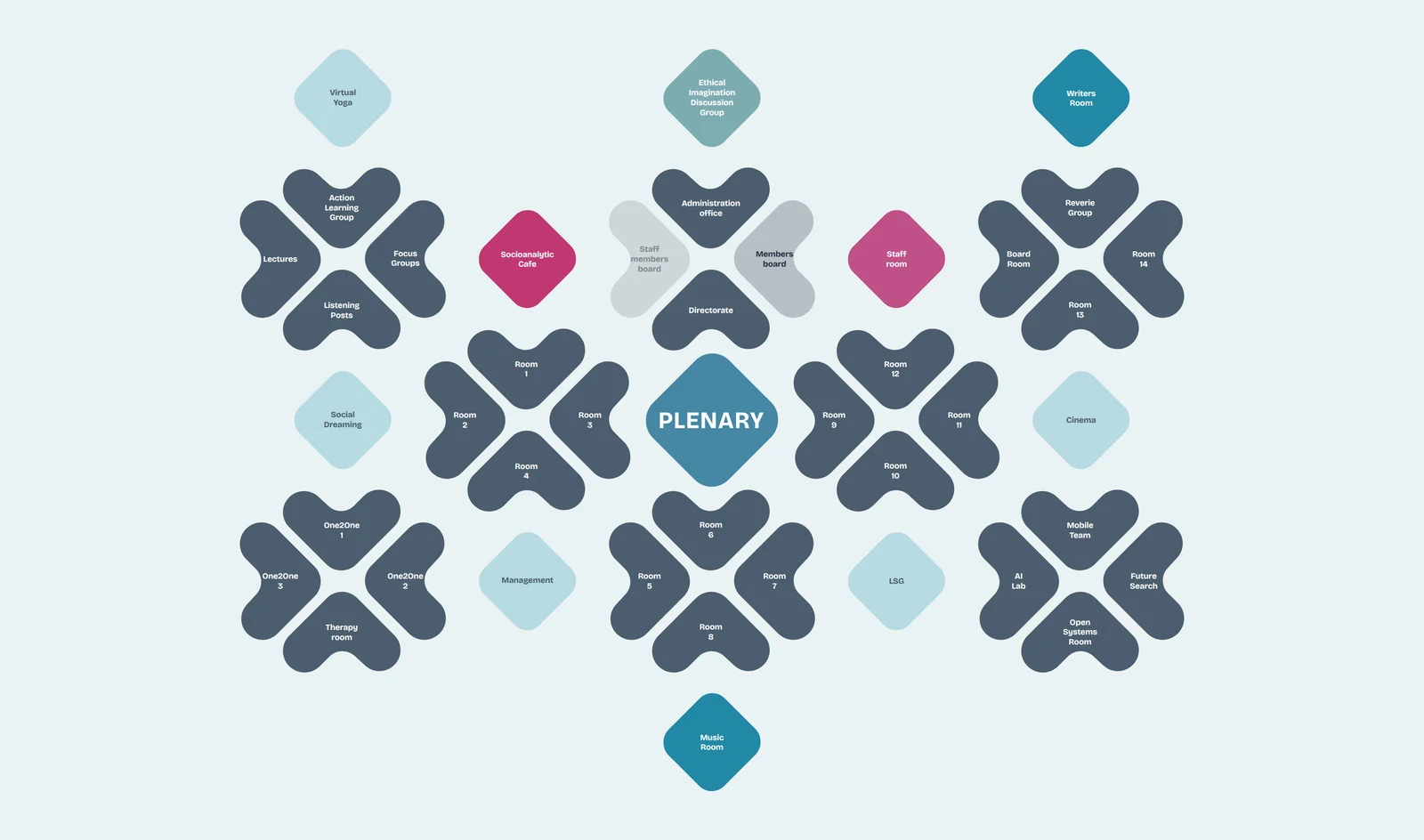
The venue as it is today, 9 October 2026: the plenary at the centre, with group rooms, the Socioanalytic Cafe, boards, the Writers Room, the Music Room and rooms for particular work around it.
How it works
Arrive. Choose a room. Take a place.
1
A venue for the event
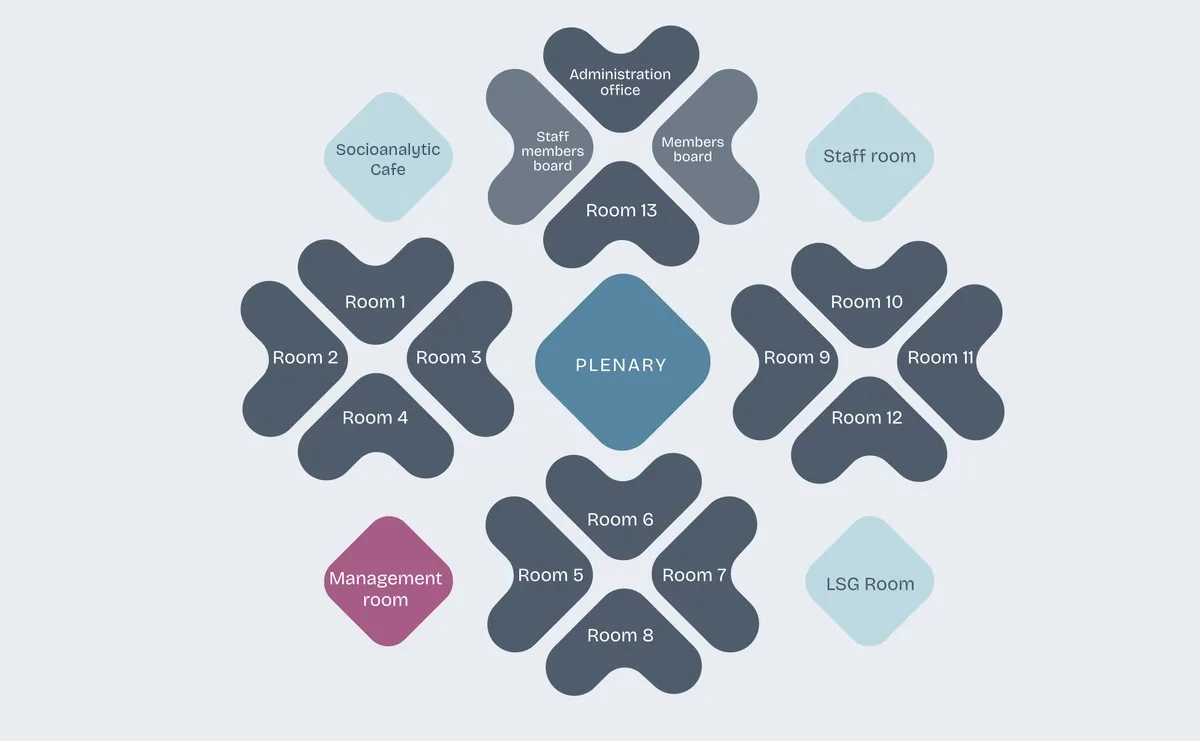
A map brings the event's rooms into relation: plenary and group spaces, the Socioanalytic Cafe, boards, staff and management rooms. Their purpose follows the event's design.
2
Chairs that carry meaning
Each room has its own seating form. Choosing a position makes proximity, visibility and role available for reflection.
3
A setting that can be prepared
Each room's layout, number of chairs and way of seeing can be prepared before an event, and a room can change its layout during it.
A venue configured for an event: plenary, group rooms, the Socioanalytic Cafe, boards, staff, management and Large Study Group rooms.
The approach
The setting is part of what we study.
A place, not a grid
An event has a map of rooms, and each room a set number of chairs in a shape: a circle, a spiral, plenary rows. People choose a room, a chair and who to sit beside, and those choices are visible to everyone. On a video call the software places you in a tile. Here, structure triggers dynamics, and a shared virtual place does not give everyone the same view or experience.
Built from inside the method
The Territory was designed based on experience of Group Relations within the Tavistock Tradition, for studying authority, role and boundary. Its architecture follows conference design: plenary, small and large group rooms, staff and management rooms, the Socioanalytic Cafe, and boards for each part of the event. Its architecture was designed from Group Relations practice and built on open-source video technology. How people work together becomes material for learning, alongside what they produce.
Technology inside the inquiry
The infrastructure is accountable and part of what is studied. The technical lead is visible and answerable to the event, a sociotechnical research role can study the platform as it is used, and when something fails it is disclosed and worked with openly. Members can study the platform alongside the work, and what they ask for shapes how it develops. This is a stance more than a feature.
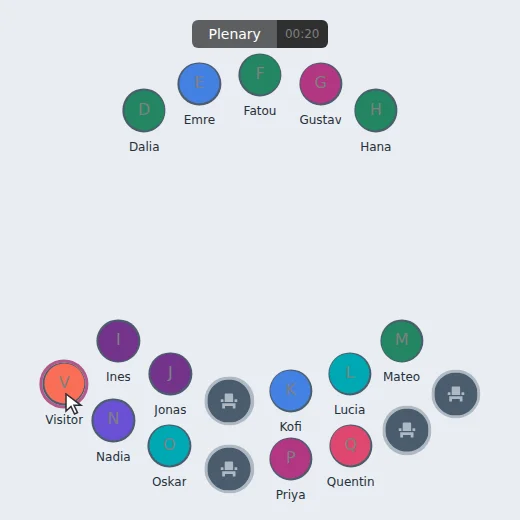
Inside a room: the Plenary, with the members’ rows facing the staff row. The people shown are test people.
Origins
How The Territory began
The VersusVirus hackathon, held during Switzerland's first Covid-19 lockdown in spring 2020; we took part from Geneva.
The early architecture discussed with Dr Leslie Brissett, former Director of the Group Relations Programme of the Tavistock Institute of Human Relations.
First pilot: “Redefining Leadership, Here and Now”, a Latin American online Group Relations Conference sponsored by the Tavistock Institute of Human Relations and co-directed with Dr Leslie Brissett, 24–28 March 2021.
The conference of the New York Center for the Study of Groups, Organizations and Social Systems, opening in Zoom and moving into The Territory.
The Territory is transformed into Alpha, named after Bion's alpha elements: a new version built on all previous experience, coded by Dr Mónica Velarde Lazarte with a team of AI agents. Dr Benedikt Hegner leads server configuration and installation. Alpha runs on our server in the UK, which we call “Good Enough”, and has now moved into pre-production, open to our wider network.
Action research, 2020 onwards: three phases
Platform development2020 to 2021
Testing in events2021 to 2025
Pre-productionfrom now onwards
Exclusive use by Socioanalytic Practice clients and the New York Center for the Study of Groups, Organizations and Social Systems2021 to 2025
Open to the networkfrom now onwards
The Territory grew from a question that became urgent during the pandemic: how could we continue to gather, learn and work together when familiar meeting places were no longer available?
During the first lockdown, in Geneva, I participated in the VersusVirus hackathon with Dr Benedikt Hegner, a physicist and computer scientist, and my husband. What stayed with me was the creativity and joy of people working together on a shared task. The experience prompted me to reconsider my reservations about online Group Relations and imagine a virtual environment in which people could move, choose where to sit and find their place in relation to others.
I brought my experience of adapting Group Relations to different organisational and social settings. Benedikt brought the technical knowledge to give those spatial ideas a working form. In April 2020, we discussed the early architecture with Dr Leslie Brissett, former Director of the Group Relations Programme of the Tavistock Institute of Human Relations, who contributed through several conversations to the platform’s name and initial logo. In March 2021, we piloted The Territory in a Latin American Group Relations conference that I co-directed with Dr Leslie Brissett, beginning with entry, negotiation and contracting in Zoom before moving into the new environment. In 2022, “Looking Backward, Moving Forward: Exploring Tavistock Group Relations in the Digital Age”, a talk and workshop for the New York Center for the Study of Groups, Organizations and Social Systems held inside The Territory, let participants meet the spatial design through experience: the virtual setting itself became part of the work.
Was it a case of Ethical Imagination?
I write as one of those who built The Territory, so what follows is a reading from inside, partial and open to correction. The platform was created during the COVID-19 lockdowns, when restrictions on gathering and travel removed the shared physical setting around which our Group Relations practice had been organised. Looking back, I think its creation may be read, tentatively, in relation to what David Armstrong called ethical imagination.1
It began from a practical dilemma rather than a theory. We did not know whether learning about authority, role and boundary could be held at a distance at all. Building a platform was one attempt to find out, among the many ways colleagues in the field were responding at the time. Its design kept the architecture of a conference—plenary, staff and members’ spaces, small groups, boards for communication across boundaries—but placed it where presence, containment and boundary had to be thought about again. In this modest sense it may have been an attempt to reimagine a form of association. A Latin American conference held on it in March 2021 was conceived by us as a pilot, rather than a replacement for residential work.2
The movement also met resistance, and much of it was our own. Among colleagues, we encountered a preference for the in-person setting and reservations about whether online conferences could be Group Relations Conferences at all, reservations that were not without foundation. In ourselves there was a reluctance to let the concept grow. We tended to replicate the model without changing the consultancy stance, and to treat the technology as a medium rather than as part of the system being studied. We also experienced difficulty in building a partnership with the Tavistock Institute of Human Relations in those years, some of which we understood as resistance. That relationship has since developed constructively.
The Territory found a home with the New York Center for the Study of Groups, Organizations and Social Systems, a relationship that led to the virtual conference Exploration in Human Relations in Shifting Virtual Environments (26–28 September 2025).3 That conference began in Zoom and then moved into The Territory. The migration itself, and the testing of a platform still in development, became data for studying the psychodynamics of testing a platform in development, through a sociotechnical research track in which members and staff worked together.
Whether the platform carried what Armstrong called a developmental undertow, I cannot yet say. If anything in The Territory deserves the name of ethical imagination, it lies less in what it achieved than in an effort, not always sustained, to treat itself, and those of us who built it, as part of what was being studied, and to accept its incompleteness.
Do you know of other initiatives that have tried to hold Group Relations work online, or of experiences that might resemble those where Ethical Imagination is found? I would be glad to hear of them, and to learn from them together in our Ethical Imagination discussion group.
Dr Mónica Velarde Lazarte
Armstrong, D. (2017). “‘Psychoanalytic Study’ and the Ethical Imagination: The Making, Finding, and Losing of a Tradition.” Organisational & Social Dynamics, 17(2), 222–234, especially pp. 222–225 and 232–233. Armstrong describes ethical imagination as the capacity actively to imagine new forms of group and organisational life in the service of human resilience and flourishing (p. 222). Drawing on an account of Bion’s wartime work, he offers a “definitory hypothesis” connecting a practical dilemma, a developmental undertow, human resourcefulness and agency, the capacity to reimagine forms of human association, and the presence and evocation of external or internal resistance (p. 224). I take these as points of reference for reflection, rather than as tests the platform passes. His closing argument cautions that interpretation, without imaginative engagement, may leave things as they were (p. 233). The application of these ideas to The Territory is mine and should not be attributed to Armstrong. ↩
Tavistock Institute of Human Relations (2021, 15 February). “Redefining Leadership HERE AND NOW.” The announcement gives the conference dates as 24–28 March 2021 and describes it as “a novel dual experiment of learning in a context of shifting territories”. The account of its conception as a pilot is my recollection. ↩
Tavistock Institute of Human Relations (2025). Conference announcement: Exploration in Human Relations in Shifting Virtual Environments. The announcement confirms the title, dates and hosting by the New York Center for the Study of Groups, Organizations and Social Systems, and describes the integration of Group Relations and sociotechnical approaches. The account of the migration, the testing of the platform and the research track’s composition is based on my participation. ↩
Case Study · A virtual Group Relations Conference · The New York Center for the Study of Groups, Organizations and Social Systems · 26–28 September 2025
Exploration in Human Relations in Shifting Virtual Environments
An account by the conference director, Dr Mónica Velarde Lazarte, who is also a co-creator of The Territory. Participants took part in the conference as an experiment, with their consent; no member is named here.
32members
17nationalities
20s–80sage range
10staff
3days
Primary task: to explore, through direct experience, the dynamics of presence, accountability, authority and leadership within evolving virtual contexts, positioning the conference as a temporary learning cooperative.
Its design studied in real time the process of testing The Territory while it was still in development, so that members could learn how the structure of the technology shapes behaviour. A third of the members were attending a Group Relations Conference for the first time. Members also differed in language, time zone and profession (consulting, psychology, education, business, the non-profit sector and the arts), and in their digital fluency; time zones affected attendance, particularly for members in Asia.
The method, adapted. The Group Relations method of the Tavistock Institute, carried into virtual environments: plenaries; small study groups of up to twelve members with a consultant; a large study group of the whole membership with two to four consultants; the Institutional Event; and Review and Application Groups to carry the learning into members' own roles.
The architecture was part of the study. The conference opened in Zoom and migrated into The Territory, so that members could study what happens to authority, belonging and accountability when the environment shifts beneath them. Rooms, chairs, permissions and the move itself were offered as material for learning, not as background. Questions that usually stay in the background came into view: Where do we meet? Who decides when we move? What happens to membership when someone cannot enter a room, hear or be heard?
Members took part in shaping the setting. The Institutional Event had a double task: to build the cooperative in the new environment, and to run a Sociotechnical Research Track studying how the virtual format influenced the method. Up to four members could join staff in a Sociotechnical Research Team; two did. In each working session, one chair in management was open to a member. Groups could ask to change the number of chairs in their rooms, altering the technical structure of the venue in a small but real way.
AI was named openly. Staff disclosed that they used AI tools for administration and reflection, and invited members to study this as part of the event.
Transparency as part of the design.
In the opening plenary the director named her double position: appointed by the Center, holding the conference's boundaries, and co-creator of the platform members were working in. Members were told that technical problems were expected and would be treated as data.
On the first day, right after the opening plenary, some members moved into The Territory on their own before the migration was launched; the platform became congested and the conference briefly split into two realities. The director asked them to return to Zoom, so that the move could happen within a shared container.
On the second day, during a session of the Large Study Group, the US hosting provider suspended the main server after classifying its traffic as suspicious. Traffic moved to fallback servers in Europe, one of which had too little network capacity: voices disappeared, images froze, and some members were dropped from the room. Management asked the Sociotechnical Research Team to obtain a post-mortem from the technical lead, and its findings were shared with the whole membership. The next day a move to Zoom was ready, and management left the decision to the Large Study Group team: the convenor of the Large Study Group stayed in The Territory, because the group was still working on its task. In the Institutional Event plenary, offered a choice between returning to Zoom and continuing in The Territory, members chose a third option: plenaries in Zoom, where clear communication mattered most, and Review and Application Groups in The Territory, where smaller groups had been working well. The closing plenary was held in Zoom; at the end, members gathered in The Territory's social space.
Two roles were kept apart. The Technical Support Lead, who built the platform, was present and answerable to the conference, not a silent programmer behind the code. A Sociotechnical Research Lead, a new role, worked with a staff member and two conference members to study the technical lead's interaction with the code, its impact on the system, and how technology shaped institutional life. Sessions in The Territory were not recorded.
Authorship: what was offered, and how it was taken up
Offered to members
What happened
Four places in the Sociotechnical Research Team
Partly taken up: two members joined.
An open chair in management
Partly taken up: members visited management during the Institutional Event.
Changes to the environment
Taken up by request: groups asked for a different number of chairs, through the research team to the technical lead. Nothing else was changed.
Changing the platform's code directly
Not taken up.
Studying the use of AI in the conference
Largely not taken up: attention went mainly to the platform and its failures.
Co-authoring the post-conference report
Not taken up.
Why these offers were taken up as they were is not known: members were not asked, and the account does not speculate.
Working in the digital medium
Relief and stability when Zoom was used at critical points.
Curiosity and a sense of novelty in a spatial environment.
Frustration and isolation when sound or video failed, especially in the Large Study Group, where there was no text chat to fall back on.
Shared adjustments: cameras switched off to save bandwidth, people telling one another when someone could not be heard, helping one another find rooms and re-enter.
Awareness of the emotional weight of being seen or unseen.
What it taught us
Virtual and hybrid conferences need sociotechnical expertise, and the technical function should not rest on one person.
Sharing a post-mortem supports trust during disruption, and a ready alternative platform lets a team stay with the work rather than improvise.
Decisions about moving platforms are best left to the team closest to the work.
Captions and other access features must be there from the start: no one asked for them, and some participants were less included.
If member authorship is part of the design, its routes must be explicit and practicable, and their take-up observed rather than assumed.
Reflection after the conference belongs in the formal design.
The negotiated use of the two platforms leaves a question for future work: how can a group respond to practical difficulties while preserving its capacity to think, participate and work?
Directorate and administration
Dr Mónica Velarde Lazarte, Conference Director
Dr Debra A. Noumair, Associate Director
Jack Mamorstein, Sociotechnical Research Lead
Dr Abigail Johnson, Lead Administrator
Claudia Velarde Vidarrauzaga, Administrator and member of the Sociotechnical Research Team
Technical support
Dr Benedikt Hegner, Technical Support Lead: not a member of the conference staff, but a member of the organisation that holds it
Consultants
Jean Cooper
Leila Djemal
Jack Lampl
Dr Yaro Fong-Olivares
Dr Flora Taylor
Hosted by the New York Center for the Study of Groups, Organizations and Social Systems; sponsored by the Tavistock Institute of Human Relations, the A.K. Rice Institute (AKRI endorsed conference), Group Relations International and Socioanalytic Practice, which provided The Territory. Much of what has been built since came from requests made through the Sociotechnical Research Team, and every event now agrees a fallback procedure with its host beforehand. This account draws on the conference's circulation-safe case study. A psychodynamic report, Authority, Containment, and Cooperative Agency in a Socio-Technical Group Relations Conference, takes up the interpretive work and awaits publication.
The Territory today
What has changed since 2025.
The first version of The Territory, built by Dr Benedikt Hegner, already ran on its own servers. In October 2026 it was transformed into Alpha, at alpha.socioanalyticpractice.com: a new version built on all previous experience, including what members and staff asked for in 2025. It is now in pre-production.
The venue
A layout for each methodCircle, spiral, plenary rows facing a staff row, snowflake, negotiation, fishbowl with an open chair, Future Search, team tables, flowers, galaxy, and polarity and triple spirals, all drawn from the designer's sketches.
Layouts that change during an eventA room can switch between the layouts chosen for it, for everyone at once: Social Dreaming from snowflake to circle, the Large Study Group between its spirals.
A venue that can be shapedRooms can be added, named, moved and coloured from the brand palette; the map grows in the venue's own design.
A chair that waits for youIf your connection drops, your chair is held for you. If you stand up on purpose, it is freed for others.
Three ways of seeingThe seated view, a speaker view and a grid; each person chooses their own.
Your organisation's nameA host's name and logo appear across the venue, alongside The Territory's.
Working together
BoardsPost-its (signed or anonymous), drawing, documents and pictures dropped onto the wall, a members' folder, a staff folder and reading material.
ProgrammesEach event has its timetable, with its dates always in calendar order. Each member sees it in their own time zone and can add all their sessions to their calendar at once.
SharingA screen, a window or a tab, or a video everyone watches together.
A Writers RoomA book written together, chapter by chapter, from Word files with their footnotes and tables. Authors suggest, each in their own colour; editors accept or reject; comments sit beside the text. Every version is numbered and kept, and anyone can download the whole book for Word. Each writer has a checklist of what waits for them, and an optional call shows only the person speaking. It can be switched on in any room. What makes it different: the writing happens inside the setting where the group works, beside its sessions and its board; the roles fit group work, and the server makes sure authors only suggest; nothing written there is used to train AI. Being built: each book locked on the server, with the key under the client’s control. Planned: opening the Writers Room to everyone in The Territory, to write together within their programmes, build theory, and prepare papers or presentations, with each client able in time to keep their writing on a server of their own.
Guided filmsShort films with their own music show members, hosts and directors around the venue.
The Socioanalytic CafeFive flowers, each its own small call. The Cafe’s page shows who sits in each flower, so you can choose where to join.
Rooms for particular work
A focus group roomResearchers can observe a group's behaviour unseen, as through a one-way mirror, and exchange private notes with the facilitators. The group is told beforehand and sees how many are observing.
The AI LabA circle with one chair outside it. For now any member may take that chair and speak from outside the circle; later we hope to place an AI agent trained in group dynamics there, only with the specific consent of those present.
One-to-one sessionsDuring a session, only the client and the practitioner can be in the room, with a private board and library for role analysis; the practitioner also keeps a board of their own, set apart from their clients' boards.
Lectures, Cinema and Music RoomRooms that open in the speaker view only, for a talk with slides, a film or music everyone shares.
Rooms for a groupA group can have its own room, host and password, with a board of its own and a page for its organisers; the room opens around the group's sessions.
Access and care
AccessibilityLive captions in English are offered to people with an accessibility need. They are produced on our own server by speech-recognition software, a form of AI, and are not kept. Each person turns them on for themselves. Each person can make the chairs larger or smaller in a room, and zoom the map.
Camera and microphoneBefore entering, you are asked to allow access to your camera and microphone. You choose when to switch each on.
RegistrationEach event can have its own application form. Registered members have My learning area, with their programme, reading material and boards, open at any time while their programme runs; their session's room opens 10 minutes before each session. Hosts can set up their account early, and it opens when their programme starts. Paid events can add a payment step after the application; free events show none.
Nothing recorded in The TerritoryThe Territory does not store sound, video or captions. Board contents are emptied from the live system 15 days after their last change, unless the client requests bespoke data gathering and provides The Territory with the participants’ consent forms.
AI by choiceAI assists in designing and developing The Territory. In sessions, AI takes part only with the specific consent of those present. The one exception is live captions, offered to people with an accessibility need (see Accessibility). If you want to use AI in your event, you can do so consciously.
By invitationOnly people given an account can enter, each with a photo of themselves, shown when their camera is off. Passwords can be reset by email.
What it does not do yet
The Territory has hosted a conference of about 40; Alpha's larger-group testing is under way.
It works best on a computer. Phones and tablets work; on a phone the map appears as a list of rooms.
Captions are in English only. Zoom inside the rooms, shared notes and more caption languages are planned.
Planned, from the technical lead's review: a test call before a first session, remembered on the server once done; dates and times shown in each person's own language and format; and "Changes since your last visit" for those who return.
Installation on a host organisation's own server is being prepared, not yet offered.
Pre-production
Come and test it with us.
From October 2026, The Territory is in pre-production. We are inviting colleagues to test it with us before it hosts its next events.
We would like to hear from members and staff of Group Relations Conferences, Listening Posts, Social Dreaming Matrices, World Cafés and Hackathons; from organisations considering an event; and from researchers interested in observed sessions and Focus Groups.
In a test session you find your way through the venue, take a chair, use the boards and captions, and tell us what you noticed, including what you felt in the room. A short feedback form follows.
Fees: taking part is free. If you are happy with your experience, you are welcome to give a testimonial or make a voluntary payment to support the pre-production phase.
What you need
A computer with a recent browser, a camera and a microphone. Chrome and Firefox have been tested; Safari and Edge are still being checked on real computers.
Headphones, so the room does not echo.
A photo of yourself, added when you first enter.
Nothing to install: The Territory opens in your browser.
To take part, get in touch through the Contact page with a line about yourself and why you would like to test. You will receive an email with a link to set your password and the date of a test session.
From January 2027 we plan a monthly Socioanalytic Cafe: a space for practitioners to meet, think together and share the conversations that matter in their work, followed by a guided tour of the venue.
Our inquiry
Questions worth staying with.
We are living through a profound technological and information revolution. The Territory offers a space to investigate, through direct experience, how new technologies enter human behaviour, relationships and collective life.
Where does authority reside in a virtual environment?
What does it mean to be present?
How does virtual collaboration become possible?
What futures do we invest in technology?
Taking part in a setting that is still being developed brings uncertainty into the room, and with it questions about confidence, trust, authority and collaboration. When familiar competence no longer tells us how to act, do we experiment, withdraw, seek reassurance, or expect someone else to restore control? Can participants criticise the platform freely when its creators also hold authority in the event, and how can feedback lead to repair without being felt as disloyalty or failure? A fault needs a practical response, and its emotional meaning deserves inquiry; studying one must not hide the other.
The ideas behind the design
Person and environment
From field theory: how do devices, bandwidth, homes, workplaces and wider circumstances shape someone’s capacity to take part?
A shared emotional field
From psychoanalytic thinking: what hopes, fears and expectations of authority arise between people, and how can they be explored without giving anyone’s experience a fixed meaning?
Social and technical interdependency
From sociotechnical thinking: how do infrastructure, roles and decisions organise participation together, and who can explain, act, repair and review?
Dependency and interdependency
Every online event relies on people and on technical systems, some of them outside anyone’s control. Participants need the developers and one another; the developers need participants’ experience to see difficulties and possibilities they could not anticipate alone. Who carries the uncertainty, and who does the work of adaptation and repair? How can mutual reliance support initiative, shared responsibility and the freedom to question?
Hosting
Begin with the purpose of the event.
Hosting brings an event's purpose into conversation with its virtual setting, its participants' needs and its technical arrangements. We agree these with each host before the event.
The setting and its authorityWho may change the setting, and how that is made clear before the work begins.
Access and orientationDevices, connections, digital fluency and accessibility needs, planned for in advance.
Support and continuityWho provides technical support, and what happens if something fails, including an alternative platform.
Data and responsibilityWhat is collected or stored, who has access, and who is responsible. During pre-production, events run on Good Enough, our server in the UK; since 7 October 2026, sound and video already pass through our server “Winnicott”, a relay in Germany.
Your own venueAn organisation’s own named venue, with its name and logo across it; installation on the organisation’s own server is being prepared.
Rooms set up for your eventRoom configurations designed for the event’s method and task: layouts, numbers of chairs, ways of seeing, and who may change them.
Orientation and documentationGuided films and orientation for members, hosts and directors, and technical documentation for the host’s team.
Design consultationOptional: working with the host on the design of the event and of its virtual setting.
Event statistics on requestFor a specific event, bespoke statistics from the application answers can be prepared on request.
The founders
Two disciplines, one undertaking.
Dr Mónica Velarde Lazarte
Socioanalyst, psychologist and co-founder
Directs Socioanalytic Practice and designed The Territory for Group Relations work. She conceptualised and coded Alpha, the current version, within an action research project carried out with a team of AI agents, studying the psychodynamics of programming in hybrid (human/AI) teams.
Built the first version of The Territory, translating spatial ideas into infrastructure for online gathering. He is the technical lead for Alpha and its quality assurer, and leads its integration into Winnicott, our server in Germany, which has relayed sound and video since 7 October 2026.
Continue the inquiry
What becomes possible when we understand the setting?
Explore the concepts, see the venue, and consider the conditions your event needs.